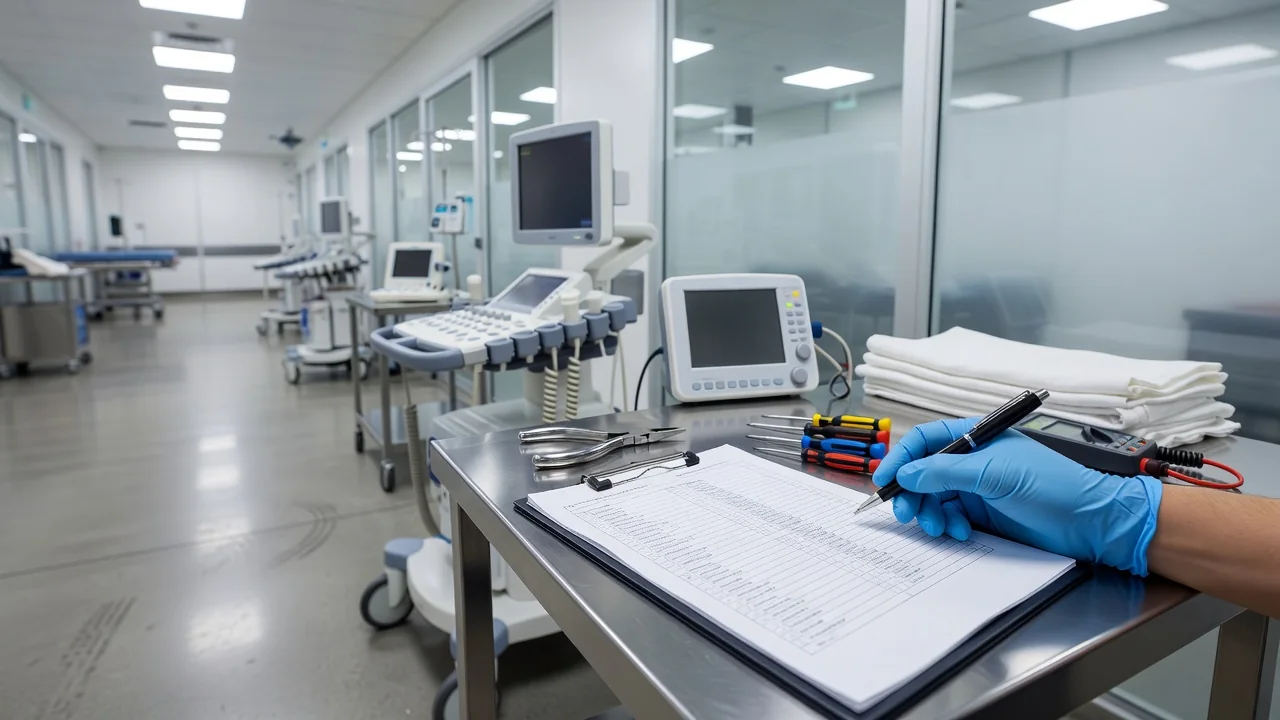
A Well-Managed Clinical Engineering Program
A well-managed clinical engineering program does far more than fix broken equipment. It evaluates service agreements for pricing and coverage, redeploys under-utilized devices to improve revenue, plans equipment replacement, and keeps the organization ready for accreditation surveys.
In the end, there is more to manage than just repairing medical equipment. This article sets out the core building blocks of a mature program and the questions leadership should ask before scaling it up.
The four pillars of a mature program
High-performing clinical engineering departments organize their work around four pillars: financial stewardship, asset utilization, lifecycle planning, and regulatory readiness. Each pillar has clear metrics, and each feeds the hospital's capital planning cycle.
- Evaluate equipment service agreements for pricing and coverage
- Deploy under-utilized medical equipment to improve revenue
- Plan equipment replacement and monitor equipment performance
- Prepare for TJC/DNV surveys and benchmark performance
Questions every hospital should ask
A program review starts with honest questions about process maturity. If the answers are mostly "no", the department is probably reactive rather than strategic.
- Do you have a technology management process to introduce new medical technology to the organization?
- Do you have a technology-specific plan to guide the acquisition process?
- Is there an efficient, effective, and equitable approach to technology acquisition and decision-making?
- Is clinical engineering involved in equipment purchases and maintenance negotiations that may produce substantial savings every year?
Service models compared
Independent service organizations (ISOs) and original equipment manufacturers (OEMs) offer healthcare organizations a wider variety of service and support capabilities than ever before. Some health systems have successfully developed their own in-house program to cover their own needs and even those of other organizations.
| Model | Strengths | Watch-outs |
|---|---|---|
| In-house program | Fast response, institutional knowledge, cost control | Recruiting, training, parts logistics |
| OEM contract | Deep device expertise, genuine parts | Premium pricing, contract lock-in |
| Independent service organization | Competitive rates, multi-vendor coverage | Variable quality, vetting required |
| Hybrid model | Balance of cost and coverage | Needs strong internal management |
From cost center to value driver
A successful clinical engineering department continuously gathers data on the financial benefits it brings to the institution. Documented savings turn the department from a cost center into a demonstrably cost-effective investment.
The largest savings usually occur in capital equipment acquisition — selection, installation, and maintenance — and in the department's involvement in clinical activities and administrative decision-making. Programs that measure these wins are the ones that grow.