
SCAT6 Sideline Assessment: How Concussion Is Tested on the Touchline
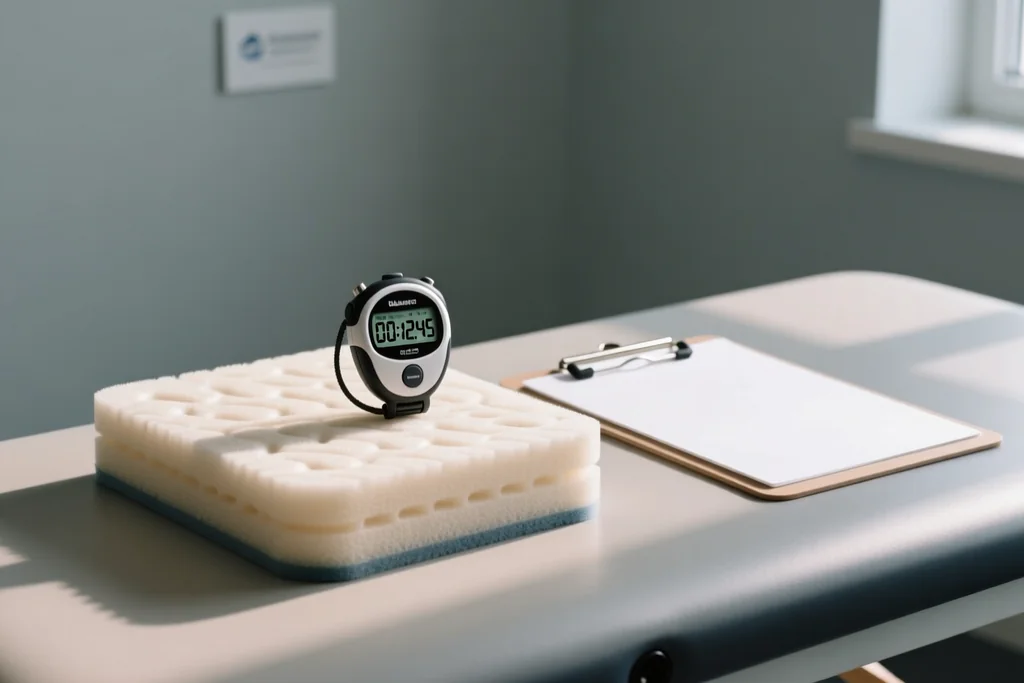
The SCAT6 sideline assessment is the standard tool for assessing concussion in sport, published in 2023 and used worldwide in the professional game. It is a structured set of tests covering symptoms, cognition, balance and coordination, and its value lies less in any single score than in the way it standardises the questions asked. Here is what the tool tests, and what it deliberately cannot do.
In football the assessment is normally carried out off the field, in a private area, which distinguishes the sport from rugby, where a pitchside head injury assessment is standard. The setting matters because the SCAT6 takes longer than a touchline conversation allows.
SCAT6 concussion test: what the assessment actually tests
The tool combines several components. A symptom checklist asks the player to rate headache, pressure in the head, neck pain, nausea, dizziness, balance problems, sensitivity to light or noise, feeling slowed down or in a fog, and difficulty concentrating or remembering. The player rates severity from zero to six.
Cognitive testing assesses orientation, immediate memory, concentration and delayed recall. Neurological screening checks the eyes, coordination and balance. In the longer version, a balance examination with a foam pad and a tandem stance adds a measure that is difficult to fake and sensitive to trouble in the vestibular system.
| Component | What it examines | Why it matters in football |
|---|---|---|
| Symptom checklist | Self-reported severity across 22 symptoms | Captures the player's own experience, including delayed symptoms |
| Immediate memory | Recall of words and details | Sensitive to acute impairment |
| Concentration | Digits backwards, months in reverse order | Measures attention, which is often affected |
| Delayed recall | Recall of the earlier word list | Useful for picking up amnesia |
| Balance and coordination | Tandem stance, foam pad, finger-to-nose, gait | Detects vestibular and motor signs |

The sideline concussion assessment tool: why the test cannot diagnose by itself
The SCAT6 is a standardised examination, not a laboratory test. It has no single cut-off that separates concussion from no concussion, and the score is only meaningful in the context of the mechanism, the player's history and the clinician's judgement.
A player who reports no symptoms but fails the balance test, or who remembers the words but cannot follow the conversation, is a concern despite an apparently reassuring score. The reverse also occurs: a player with a mild score who has clearly been dazed after a collision.
The baseline problem in professional football
Comparing an assessment with a pre-season baseline improves sensitivity, and many professional clubs collect baseline data. The difficulty is practical: squads change, players join mid-season, and baseline tests are themselves affected by sleep, effort and level of motivation.
- Collect baselines consistently, at the same point in the season and under similar conditions.
- Treat a missing or stale baseline as a limitation to be acknowledged, not a reason to skip the examination.
- Use the examination alongside video of the mechanism and the player's own account.
What happens after the conclusion is reached
A positive assessment ends the player's involvement in the match and starts the pathway described in concussion return to play. An inconclusive assessment leads to removal and observation, because the risk of missing a concussion is not symmetrical with the cost of a substitution.
The same tool is used away from matchday. The SCOAT6, the office version, structures a follow-up assessment in the days after the injury and helps decide when a player can begin exercise and when he can progress. Together with the sports concussion protocol covered in the football concussion protocol, it forms the assessment spine of the modern approach.
Five minutes that change a fortnight
An assessment carried out properly takes longer than the stoppage that follows a head clash, and it is usually completed in the dressing room or a medical room rather than at the side of the pitch. That is a deliberate trade: a few extra minutes of assessment in exchange for a decision that is defensible and, more importantly, correct.
Players sometimes read the delay as hesitation. In practice it is the opposite: the protocol expects the examination to be thorough, and the decision to remove a player is made early and on the basis of the whole picture rather than on a single score.
Common misconceptions about the test
Players often believe that answering the memory questions correctly proves they are fine. In practice, the symptom checklist and the balance components carry substantial weight, and delayed recall is scrutinised specifically. A player who arrives at the assessment determined to pass will usually be detected by the parts of the test that do not depend on effort.
The other misconception is that a normal scan proves there is no concussion. Standard imaging is normal in the overwhelming majority of sports concussion cases, and it is used to exclude serious structural injury rather than to confirm the diagnosis.
Information only. This guide is for general information about injuries in professional football and does not replace assessment, diagnosis or treatment by a qualified clinician.
Read next
Concussion Protocol in Football: The Premier League Rules
A head injury assessment, a temporary substitute and a minimum rest window. The football concussion protocol, step by step, in plain English.
2026-09-24
Heading and Subconcussive Head Impacts in Football
A header is not a concussion. Repeated thousands of times across a career, it is still an exposure clubs now count and dose deliberately.
2026-09-11
Concussion Return to Play: The Six Steps Back to Football
Light activity, running, non-contact training, contact, full training, match. Six steps, each separated by rest, and none of them negotiable.
2026-09-05