
ACL Rehab Phases in Football: The Five Stages, Week by Week
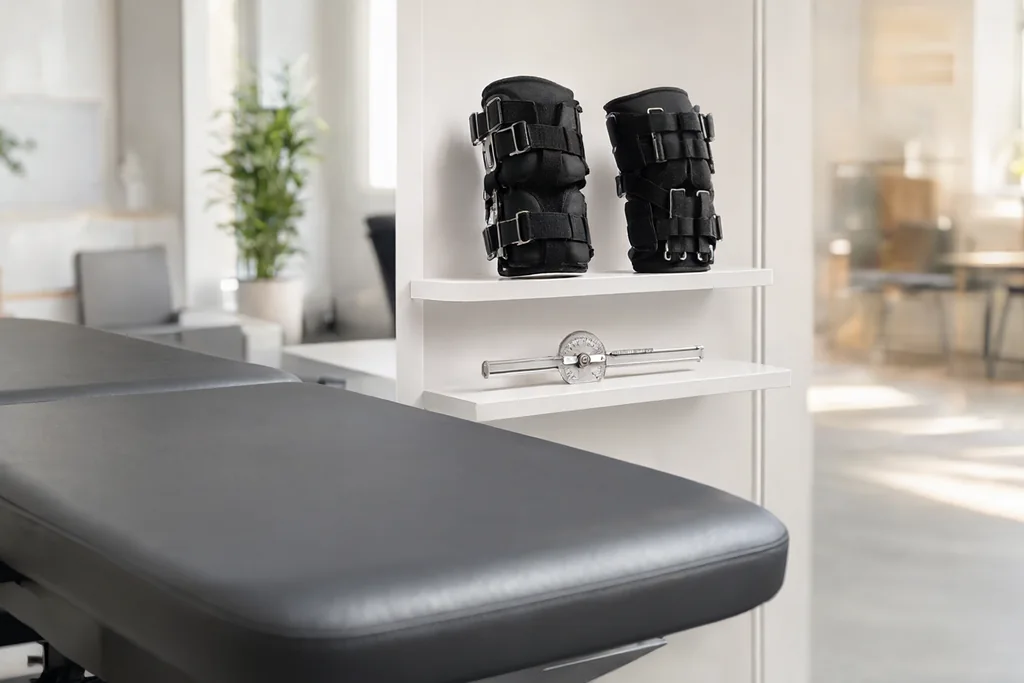
ACL rehab phases exist because a reconstructed knee cannot be judged by how it feels. Each phase in the sequence has an entry criterion, a set of goals and an exit test, and players often feel ready in the middle of the programme while the graft is still maturing. The structure is what keeps the timeline honest, and it is why the phases are never skipped in a professional setting.
The five phases below describe the standard progression for an professional from the first days after surgery to the return-to-sport battery. Individual programmes differ, but the logic does not.
ACL rehab phases: phase one, protection and quadriceps control
The first days and weeks are about controlling swelling and waking up the quadriceps. Full passive extension is the priority, because a knee that cannot straighten will not walk normally and will not run properly later. Swelling is managed with elevation, compression and controlled icing, while the player works on quadriceps sets, straight-leg raises and patellar mobilisation.
Weight bearing is usually allowed early and progressed with crutches, with the exact protocol depending on whether a meniscus was repaired at the same time. The exit criterion is simple: a straight knee, minimal swelling and a visible quadriceps contraction.
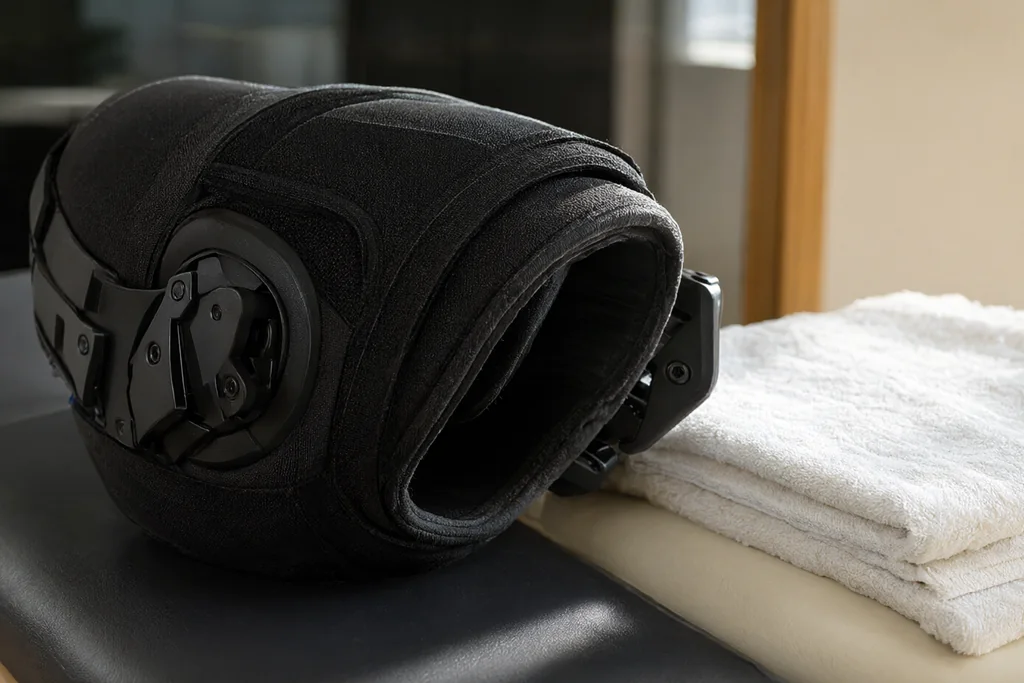
Phases two and three: from walking to running
Phase two builds load: cycling, leg presses, squats to a controlled depth, and single-leg work as tolerated. Phase three introduces running, and running after ACL reconstruction is a milestone that has to be earned with symmetric walking, no reactive effusion and adequate single-leg strength.
| Phase | Main goal | Exit criterion |
|---|---|---|
| One: protect and activate | Full extension, swelling control, quad activation | Straight knee, minimal effusion, visible quad contraction |
| Two: load the knee | Progressive strength in gym patterns | Pain-free squat and leg press, normal walking |
| Three: run | Gait symmetry, straight-line speed | No swelling after running, symmetric gait |
| Four: control and chaos | Landing, cutting, deceleration, perturbation | Hop test symmetry, good landing mechanics |
| Five: return to sport | Full training, contact, confidence | Complete test battery passed and clearance signed |
Phase four is where comebacks are won
Phase four adds the movements that actually break knees: decelerating at speed, jumping and landing on one leg, changing direction under time pressure, and reacting to an opponent. Strength numbers can look excellent while landing mechanics remain poor, which is why video assessment and force-plate data matter here.
Progressions are usually built around targets rather than fixed sets. Land on one leg with a quiet, controlled knee, then add a ball, then add a defender, then add a decision.
Phase five: the return-to-sport battery
The last phase is not training, it is examination. It combines isokinetic and handheld strength testing, a hop test series, sport-specific drills, and a structured conversation about confidence and fear of re-injury.
- Strength: quadriceps and hamstring symmetry against the uninjured side, usually with a 90 percent threshold as the traditional minimum.
- Hop series: single-leg hop for distance, triple hop, crossover hop and a timed six-metre hop.
- Movement quality: landing mechanics and cutting technique reviewed on video.
- Exposure: a graded reconditioning block before full training, described in reconditioning blocks.
Keeping the rest of the athlete working
A long knee rehabilitation is a whole-body problem. A player who spends three months off his feet loses triceps surae capacity, trunk strength, aerobic fitness and the ability to tolerate repeated sprints. Those losses are usually harder to recover than the knee itself.
Good programmes therefore keep the upper body, the opposite leg and the aerobic system loaded from the earliest safe point. Swimming, cycling, seated strength work and modified field conditioning all have a place, and they shorten the final phase considerably.
The psychological side needs the same attention. Months of gym work without a ball or a team is a recognised risk period, and clubs increasingly plan contact with the squad, individual technical work and clear short-term targets into the timetable.
The ACL rehabilitation protocol: how long the five phases take
The phases do not map neatly onto weeks, and any programme that claims they do should be treated with caution. For an isolated reconstruction in an professional, phase one is usually measured in weeks, phases two and three in months, and phase four in the couple of months before full training.
Roughly, the first three months establish a working knee, months four to six build an athlete who can run and change direction, and the final block converts that athlete into a footballer who can compete. A player who arrives at month six without having done phase four work has not skipped a phase; he has compressed it, and the compression shows up in the test battery.
ACL rehab timeline: signs to slow down rather than push on
Reactive swelling that appears the morning after a session, a knee that feels unstable when turning, and a player who starts protecting the joint without being asked are all reasons to step back a phase. Slowing down for two weeks costs far less than a second rupture. The criteria that finally release a player into competitive football are set out in return-to-play criteria.
Information only. This guide is for general information about injuries in professional football and does not replace assessment, diagnosis or treatment by a qualified clinician.
Read next
ACL Injury Recovery Time: What Six to Nine Months Really Means
A ruptured ACL costs most professionals six to nine months. Here is what fills that window and why the last two months are the hardest.
2026-09-26
ACL Graft Choice: What Each Option Means for Rehab
Bone-patellar tendon, hamstring tendon or donor tissue: the graft choice shapes the first four months of rehab and the long-term re-injury picture.
2026-09-21
ACL Re-injury Risk: Which Tests Actually Predict It
A 90 percent limb symmetry index is a starting line, not a finish line. The tests that carry real predictive weight before an ACL return.
2026-09-09