
ACL Re-injury Risk: Which Tests Actually Predict It
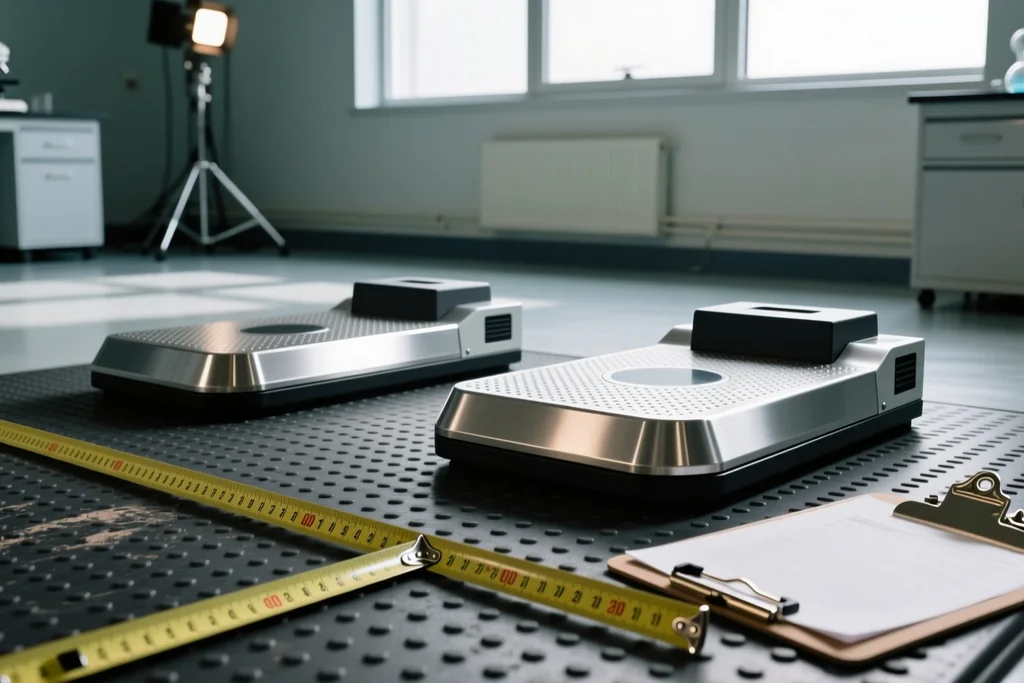
ACL re-injury risk is no longer estimated from a calendar, and it is no longer estimated from how the knee feels on a Tuesday. Clearing a footballer after reconstruction is a testing decision: limb symmetry, hop tests, force-plate data and psychological readiness are combined to estimate how likely the graft is to fail under match load. No single measurement answers that, so clubs build a battery and set thresholds.
The numbers below are the ones most often quoted in professional practice for players. They are thresholds used to guide a judgement, not automatic pass marks.
ACL re-injury risk: limb symmetry, the number everyone quotes
A limb symmetry index compares the operated leg with the healthy one. For quadriceps and hamstring strength it is normally calculated from isokinetic dynamometry at slow and fast speeds, with handheld dynamometry used in settings where a full laboratory is not available.
A limb symmetry of 90 percent is the traditional minimum before a return to full training is considered, and it is quoted as a floor rather than a ceiling: the argument is that a player who sprints for a living should be held to a higher bar, and that the absolute value on the healthy side matters as much as the ratio. It is a conventional threshold rather than a published constant, which is why the rest of the battery matters more than the single figure.
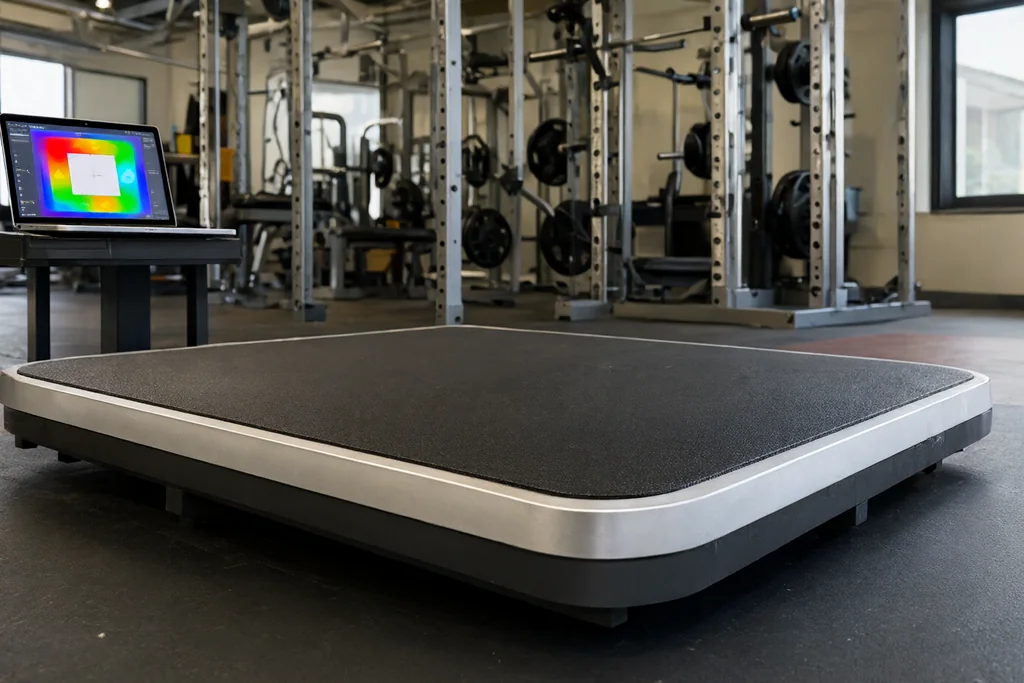
The ACL return to sport test battery: the hop test series
| Test | What it measures | Typical threshold |
|---|---|---|
| Isokinetic quad strength | Concentric and eccentric strength deficit | 90 percent limb symmetry (traditional minimum) |
| Single-leg hop for distance | Power and confidence on one leg | 90 percent limb symmetry (traditional minimum) |
| Triple and crossover hop | Control through repeated landings and rotation | 90 percent limb symmetry (traditional minimum) |
| Timed six-metre hop | Speed of force production | Within 10 percent of the other side |
| Drop jump on force plates | Landing mechanics and asymmetries invisible to the eye | Club-specific asymmetry limits |
What force plates see that the eye misses
A player can pass a hop test while still offloading the operated knee. Force plates show how quickly each leg produces force, how long ground contact lasts on each side and whether the timing of the two legs is symmetrical.
These asymmetries often survive long after pain has gone, and they are considered one of the reasons re-injury risk stays elevated in the first two years. A quiet landing on the operated leg is a better sign than a long jump on it.
Confidence is a measured variable
Psychological readiness has its own validated questionnaire, and it is not a soft add-on. Players who report low confidence in the knee tend to load it differently, and those patterns show up both in testing and in match movement.
- Ask directly about fear of re-injury, hesitation in duels and avoidance of certain turns.
- Compare self-report with video evidence rather than accepting either alone.
- Treat a confident player who fails a strength test as unsafe, and an anxious player who passes everything as unfinished.
When the battery is run, and how often
Testing starts long before the decision it informs. Strength and hop measures are taken at several points through rehabilitation so that the trend is visible, and a plateau is easier to spot than a single failed test.
The full battery is normally repeated twice: once to decide whether the player can join full training, and once before competitive minutes. Repeating it matters because a player who passes in June after a light programme may not pass in August under real training load.
- Test early and often enough to see the curve, not just the endpoint.
- Run the battery in the same order each time so results are comparable.
- Retest after the first weeks of full training, when accumulated load exposes deficits.
Why the first two years stay risky
Re-injury statistics are stubbornly front-loaded. The highest risk period runs from the return to sport through the following eighteen months, and it applies to both the operated knee and the opposite one, whose ligament was never damaged.
The explanation usually combines three things: asymmetries that survive the test battery, a return to the same high-risk movements that caused the first injury, and the simple fact that available playing time is not the same as tolerated playing time. A player back at six months may be cleared; he is not yet equivalent.
Clubs respond by capping minutes, by managing consecutive fixture blocks and by keeping the strength and landing programme running through the season rather than dropping it once the player is available. Load management is part of the same protection.
No test battery can promise a safe return
Every component of the battery correlates with risk; none of them eliminates it. This is why the final decision is a shared one between surgeon, physiotherapist, sports scientist, coach and the player, and why the first months back are managed as a graded exposure rather than a fixed number of minutes.
The practical sequence is to pass the tests, then complete an on-field reconditioning block, then accept squad minutes before starting places. The underlying programme is described in the five phases of ACL rehabilitation.
Information only. This guide is for general information about injuries in professional football and does not replace assessment, diagnosis or treatment by a qualified clinician.
Read next
ACL Injury Recovery Time: What Six to Nine Months Really Means
A ruptured ACL costs most professionals six to nine months. Here is what fills that window and why the last two months are the hardest.
2026-09-26
ACL Graft Choice: What Each Option Means for Rehab
Bone-patellar tendon, hamstring tendon or donor tissue: the graft choice shapes the first four months of rehab and the long-term re-injury picture.
2026-09-21
ACL Rehab Phases in Football: The Five Stages, Week by Week
Quad control, walking, running, control-chaos and the return test. The five phases of ACL rehab and the criteria that gate each one.
2026-09-15